RPZ vs. Double Check Valve: What Is the Difference?
By Glenn, Licensed Master Plumber #5822Last updated
The difference is the relief valve. A reduced pressure zone (RPZ) assembly has two check valves with a relief valve between them, and it is used on high-hazard connections. A double check valve assembly has two check valves and no relief valve, and it is used on lower-hazard connections.
Both are testable backflow prevention assemblies, and both need a yearly test by a certified tester. Here is how they compare.
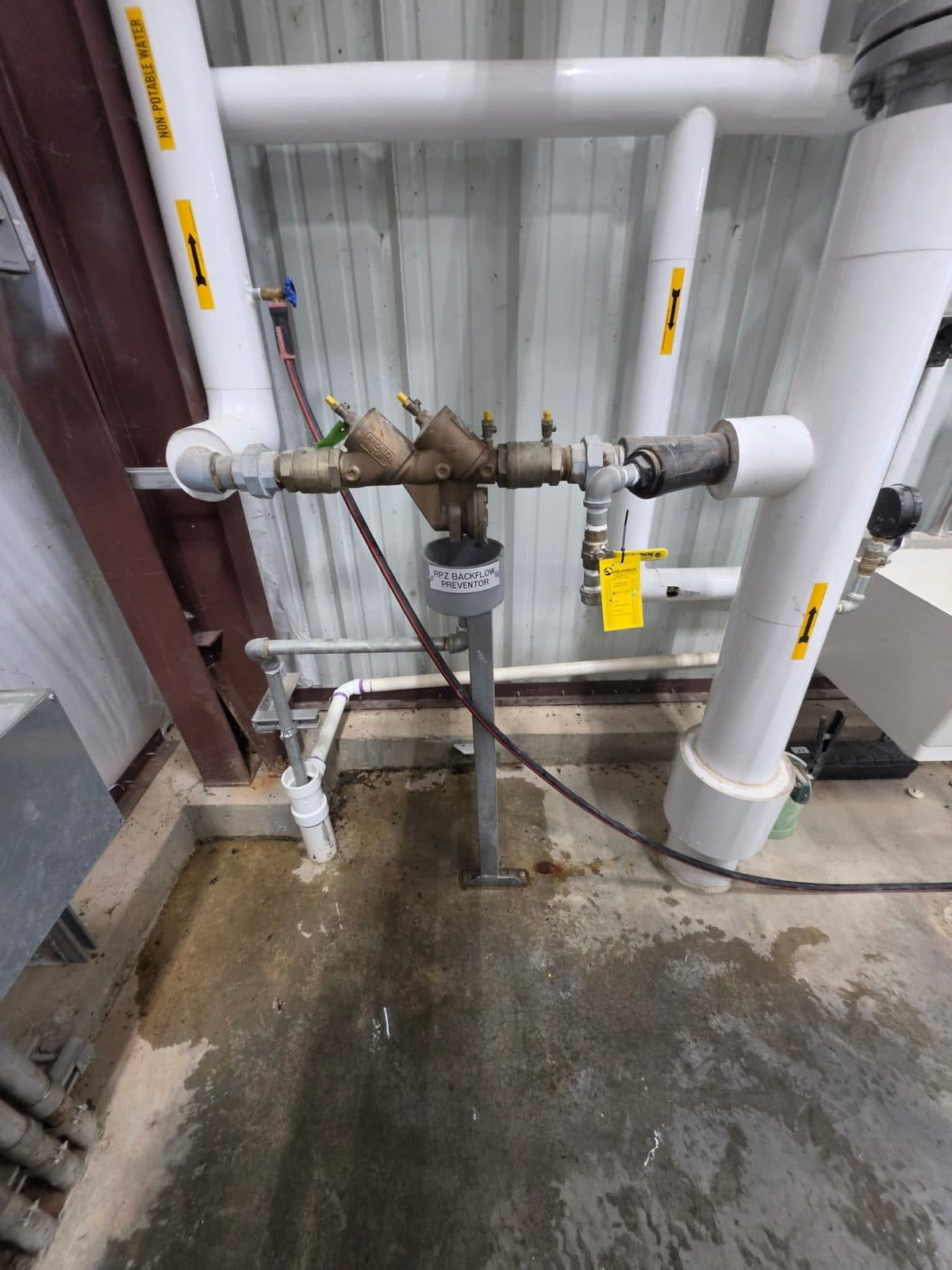
How does an RPZ assembly work?
An RPZ has two independent check valves. The space between them, called the zone, is kept at a lower pressure than the supply side. A relief valve connects that zone to the outside.
If either check valve leaks, or if pressure on the supply side drops, the relief valve opens and dumps water out of the zone. That is on purpose. It is better for water to spill onto the ground than to flow back into the public supply. Because of that, an RPZ has to be installed above ground where the discharge can drain away and the relief valve can never sit underwater.
How does a double check valve assembly work?
A double check valve assembly has two independent check valves in a row, each held closed by a spring. If one check fails, the other still blocks backflow. There is no relief valve, so it does not dump water.
That makes it simpler and easier to place, but it gives less protection than an RPZ. It is meant for connections where backflow would be a nuisance or would affect water quality, but would not create a health hazard.
How do RPZ and double check assemblies compare?
| Feature | RPZ (reduced pressure zone) | Double check valve assembly |
|---|---|---|
| Check valves | Two | Two |
| Relief valve | Yes, between the checks | No |
| Hazard level | High hazard (health risk) | Lower hazard (non-health) |
| Discharges water | Yes, when it senses a problem | No |
| Where it can go | Above ground, with room to drain | More flexible, can be in some vaults or indoors |
| Common uses | Boilers, chemical feed, many commercial kitchens, some irrigation | Many fire sprinkler lines, lower-hazard commercial connections |
| Annual test required | Yes, by a certified tester | Yes, by a certified tester |
Which one does my property need?
Your water provider decides, based on what is connected on your side. If the connection could put something harmful into the water, such as a chemical feed or a boiler with additives, an RPZ is usually required. If the risk is lower, a double check valve assembly may be allowed.
If you are building, remodeling, or adding a sprinkler or fire line, check with your water provider before anything is installed. Putting in the wrong type can mean replacing it later.
Why is my RPZ dripping water?
A little discharge from an RPZ relief valve is the assembly doing its job, but constant dripping or dumping usually means something is wrong. Common causes are debris on the first check valve, a worn relief valve seal, or pressure swings on the supply side. It should be looked at by a certified repair technician. We repair RPZs on-site under Backflow Repair certification #RT-466.
What about pressure vacuum breakers?
A pressure vacuum breaker (PVB) is another testable device you will often find on lawn irrigation systems. It has one spring-loaded check valve and an air inlet that opens if pressure drops. It protects against back-siphonage but not backpressure, so it is only allowed where backpressure cannot happen. Like RPZs and double checks, it needs a yearly test.
Do RPZs and double checks test differently?
Yes. On a double check, the tester confirms each check valve holds tight. On an RPZ, the tester also checks the pressure difference across the first check and the point where the relief valve opens. Both tests are done with a calibrated test kit, and both results go on the report your water provider requires.
Need Help With This?
Need backflow testing for RPZ and double check assemblies? Glenn is a licensed master plumber serving the River Valley. Call or text (479) 719-1263.